Comparative Analysis: High-Pressure vs. Low-Pressure Welding in Polyethylene (PE) Butt Fusion: ISO/DVS vs. ASTM Standards
Views : 1736
Update time : 2026-03-28 14:32:46
Comparative Analysis: High-Pressure vs. Low-Pressure Welding in Polyethylene (PE) Butt Fusion: ISO/DVS vs. ASTM Standards
Introduction
The terms "high-pressure welding" and "low-pressure welding" are common but informal designations in the polyethylene (PE) pipe industry, referring specifically to the fusion pressure applied during the butt fusion process. These terms describe the fundamentally different approaches to calculating fusion pressure in the two major global standards: ISO/DVS (European) and ASTM (North American). This article clarifies the technical distinctions, calculation methodologies, and practical implications of these two approaches.
1. Core Distinction: Calculation Coefficients
The primary difference lies in the pressure coefficient used in the formula to determine fusion pressure.
Standard
Typical Drag Pressure Coefficient
Industry Designation
Calculation Philosophy
ISO / DVS
0.15 N/mm² (≈ 1.5 bar)
"Low-Pressure Welding"
Achieve sufficient molecular diffusion with the minimum necessary pressureto prevent excessive bead formation and material deformation.
ASTM F2620
0.3 N/mm² (≈ 4.3 psi, 3.0 bar)
"High-Pressure Welding"
Apply a higher, more conservative pressureto ensure complete fusion under variable field conditions, providing a greater safety margin.
Formula (Simplified):
Fusion Pressure (Force) = Pressure Coefficient × Pipe Cross-Sectional Area
2. Detailed Comparative Table
Aspect
ISO/DVS (Low-Pressure Welding)
ASTM (High-Pressure Welding)
Pressure Coefficient
0.15 N/mm² (PE100)
0.3 N/mm² (approx. double ISO)
Resulting Force
Lower calculated force for the same pipe size.
Higher calculated force (often ~2x ISO for same pipe).
Bead Formation
Smaller, more uniform internal/external beads.
Larger, more pronounced beads, especially the internal bead.
Philosophy
Precision engineering: Optimize pressure for material flow without over-stressing.
Robust engineering: Apply ample pressure to overcome minor surface irregularities and ensure bonding.
Equipment Tolerance
Requires high precision in facing, alignment, and temperature control. More sensitive to pressure deviation.
More forgiving of minor imperfections due to higher force. Requires machines capable of higher pressure output.
Primary Regions
Europe, Middle East, Africa, Asia, Oceania.
North America, parts of Latin America, and projects with U.S. specifications.
3.
3.Critical Clarifications and Misconceptions
Myth: "High-Pressure Welding is Stronger."
Fact: Both methods, when performed correctly per their respective standards, produce joints that are 100% as strong as the parent pipe material. The strength comes from complete molecular interdiffusion, not the magnitude of the force applied.
Myth: "Low-Pressure Welding is for Low-Pressure Pipes."
Fact: The "low-pressure" refers only to the welding force, not the pipe's pressure rating. ISO/DVS welding is used for the highest pressure PE piping systems (e.g., PE100, PN25 gas networks).
Absolute Rule: Never Mix Parameters.
Using an ASTM coefficient on a machine set for ISO procedures (or vice versa) will result in grossly incorrect pressure, leading to either cold welds (under-fusion) or excessive bead formation with material weakening (over-fusion).
4. Practical Implications for Engineers and Operators
Consideration
ISO/DVS (Low-Pressure)
ASTM (High-Pressure)
Machine Setup
Must ensure the correct coefficient (e.g., 0.15) is programmed.
Must ensure the correct coefficient (e.g., 0.3) is programmed.
Visual QC
Check for a uniform, continuous bead of moderate size.
Expect a larger, more prominent bead.
Common Pitfalls
Insufficient pressure due to incorrect coefficient or machine error → risk of cold weld.
Excessive pressure can cause "over-butt," thinning the pipe wall near the joint.
Documentation
Welding reports must specify the standard and parameters used.
Welding reports must specify the standard and parameters used.
5. Side-by-Side Comparison for a 250mm OD, SDR11 PE100 Pipe
Parameter
ISO/DVS (0.15 N/mm²)
ASTM (0.3 N/mm²)
Wall Thickness
22.7 mm
22.7 mm
Cross-Sectional Area
~170 cm²
~170 cm²
Calculated Drag Force
~2,550 N
~5,100 N
Machine Gauge Pressure
Lower setting
Approximately double the ISO setting
Resulting Bead
Smaller, controlled
Larger, more voluminous
Joint Strength
Full strength (when procedure is followed)
Full strength (when procedure is followed)
6. In this landscape of two dominant standards, the SMART JOINT series( some models) of butt fusion machines is engineered to deliver uncompromising precision, reliability, and ease of use for both ISO/DVS (low-pressure) and ASTM (high-pressure) welding methodologies.
Dual-Standard Intelligence: Some models of SMART JOINT machines are designed ok for both ISO/DVS and ASTM standards.
Optimized for High-Integrity Joints: Whether executing a precision low-pressure weld for a large size robust high-pressure weld for industrial process piping, SMART JOINT's consistent alignment, accurate temperature, and precise welding pressure control ensure a perfect, full-strength fusion joint every time, with the ideal bead profile for the related standard.
7. Conclusion and Recommendations Both ISO/DVS and ASTM are equally valid and produce high-integrity joints when their full procedure (including heating time, temperature, and cooling) is followed correctly. The choice between "high-pressure" (ASTM) and "low-pressure" (ISO/DVS) welding is typically dictated by project specification, geographic location, or client requirements, not by technical superiority.
References:
ISO 21307:2017 — Plastics pipes and fittings — Butt fusion jointing procedures for polyethylene (PE) pipes and fittings...
DVS 2207-1 — Welding of thermoplastics — Heated tool welding of pipes and fittings made of polyethylene (PE)...
ASTM F2620 — Standard Practice for Heat Fusion Joining of Polyethylene Pipe and Fittings
PPI (Plastics Pipe Institute) Handbook of Polyethylene Pipe — Chapter 11: Heat Fusion Joining
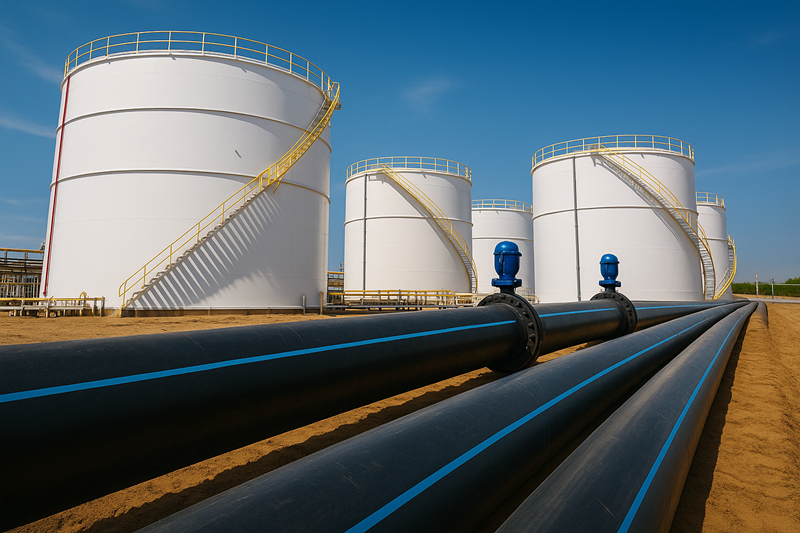
In the OIL & GAS industry, PE fittings are primarily used in low-pressure, non-high-temperature, corrosive environments, and areas with special safety and environmental requirements. SMART JOINT provides robust and corrosion‑resistant HDPE piping systems for the oil and gas industry, supporting applications from produced water management and gas gathering to pipeline protection and spill containment.
Smart Joint specializes in delivering comprehensive HDPE piping solutions up to 2500mm, supported by a full range of fittings, fusion machinery, and professional fabrication services.
PE pressure pipes are designed for a long lifetime (in excess of 100 years) in the subsurface infrastructure. To guarantee the whole pipeline life span under the designed pressure, it’s necessary to select non pressure derating HDPE fittings.




 3.
3.